The following definitions are for advanced USB users who intend to develop a specific USB device not provided in ASF.
Figure 1. Internal USB Device API Overview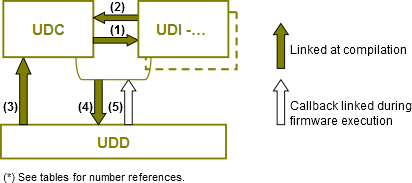
| Declaration | Description | |
|---|---|---|
| bool (*enable)() | Called by UDC to enable/disable a USB interface | |
| void (*disable)() | ||
| bool (*setup)() | Called when a USB setup interface request is received | |
| uint8_t (*getsetting)() | Called by UDC to obtain the current alternate setting of a USB interface | |
| uint8_t (*sof_notify)() | Called by UDC to notify a SOF event at USB interface enabled | |
Note: The UDI API is linked with the UDC module via the UDC descriptor configuration
file.
| Declaration | Description |
|---|---|
| usb_iface_desc_t* udc_getiface() | Gives the USB interface descriptor selected by UDC when UDI is called (Table 1) |
| Declaration | Description |
|---|---|
| void udc_reset() | Called when Reset bus state occurs |
| bool udc_process_setup() | Called when a setup packet is received |
| Declaration | Caller | Description |
|---|---|---|
| void udd_enable() | UDC | Enables/disables the USB Device mode |
| void udd_disable() | UDC | |
| void udd_attach() void udd_dettach() |
UDC | Inserts or removes pull-up on USB line |
| void udd_set_address(uint8_t add) | UDC | Changes/returns the USB device address |
| uint8_t udd_getaddress() | UDC | |
| bool udd_is_high_speed() | UDC/UDI | In case of USB HS device, then checks speed chosen during enumeration |
| uint16_t udd_get_frame_number() | APP | Returns the current start of frame number |
| udd_send_wake_up() | APP | The USB driver sends a resume signal called “Upstream Resume” |
| bool udd_ep_alloc(usb_ep_id_t ep, uint8_t bmAttributes, uint16_t wMaxPacketSize) | UDC | Enables/disables endpoints |
| udd_ep_free(usb_ep_id_t) | UDC | |
| bool udd_ep_clear_halt(usb_ep_id_t) | UDC/UDI | Clears/sets/gets the endpoint state (halted or not) |
| bool udd_ep_set_halt(usb_ep_id_t) | ||
| bool udd_ep_is_halted(usb_ep_id_t) | ||
| bool udd_ep_wait_stall_clear( udd_ep_id_t endp, udd_callback_nohalt_t callback) | Registers a callback to call when endpoint halt is removed | |
| bool udd_ep_run( usb_ep_id_t endp, bool b_shortpacket, uint8_t *buf, uint32_t u32_size_buf, udd_callback_trans_t callback) | UDI | Starts/stops a data transfer in or out on an endpoint Note: The control endpoint is not authorized here |
| udd_ep_abort(usb_ep_id_t endp) | UDI |
| Declaration | Description |
|---|---|
| typedef void (*udd_callback_nohalt_t) (void); | Called when the halt on endpoint is removed.
This one is registered via udd_ep_wait_stall_clear(). |
| typedef void (*udd_callback_trans_t) (udd_ep_status_t status, iram_size_t nb_transfered) | Called when a transfer request is finished or canceled. This one is registered via udcdrv_ep_run(). |
| Declaration | Caller | Description |
|---|---|---|
| uint16_t udd_get_microframe_number() | APP | Returns the current micro start of frame number |
| udd_test_mode_j() | UDC | Features to test the USB HS device. These are requested to run a USB certification. |
| udd_test_mode_k() | UDC | |
| udd_test_mode_se0_nak() | UDC | |
| udd_test_mode_packet () | UDC |
The global variable udd_g_ctrlreq is declared by UDD and contains two parts:
- Values updated by UDD and used by UDC and UDIs (Table 7)
- Values updated by UDC and UDIs and used by UDD (Table 8)
Outside the UDD, this variable is processed by udc_process_setup() for UDC and *setup() for UDI.
| Declaration | Description |
|---|---|
| usb_setup_req_t req | Values included in SETUP packet and used to decode request. |
| uint8_t *payload | The content of the buffer is sent or filled by UDD. Can be NULL if u16_size is equal to 0. |
| Declaration | Description |
|---|---|
| uint8_t *payload | Pointer value of the buffer to send or fill |
| uint16_t u16_size | Buffer size to send or fill It can be 0 when no DATA phase is needed |
| bool over_under_run(void) | Called by UDD when the buffer given (.payload) is full or empty. Can be NULL |
| void *callback(void) | Called by UDD when the setup request is finished (setup+data+ZLP). Can be NULL |