An ideal n-bit single-ended ADC converts a voltage
linearly between GND and VREF in 2n steps (LSb). The lowest
code is read as 0, and the highest code is read as 2n-1.
Several parameters describe the deviation from the ideal behavior:
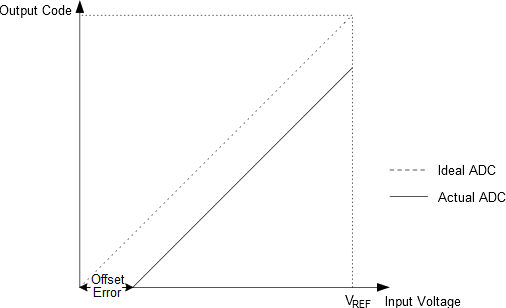
- Offset Error
- The deviation of the first transition (0x000 to
0x001) compared to the ideal transition (at 0.5 LSb). Ideal
value: 0 LSb. Figure 1. Offset Error
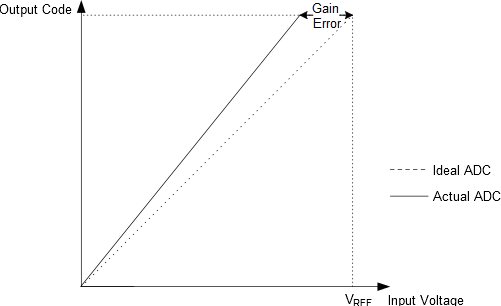
- Gain Error
- After adjusting for offset, the gain error is
found as the deviation of the last transition (0x3FE to 0x3FF)
compared to the ideal transition (at 1.5 LSb below maximum).
Ideal value: 0 LSb.Figure 2. Gain Error
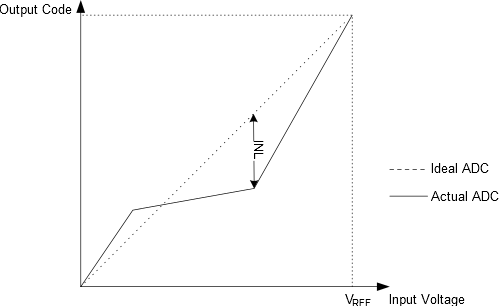
- Integral Non-Linearity (INL)
- After adjusting for offset and gain error, the
INL is the maximum deviation of an actual transition compared
to an ideal transition for any code. Ideal value: 0 LSb.Figure 3. Integral Non-Linearity
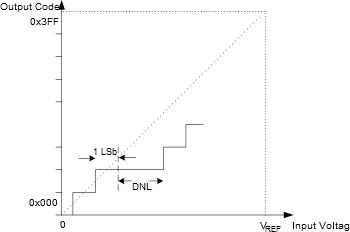
- Differential Non-Linearity (DNL)
- The maximum deviation of the actual code width
(the interval between two adjacent transitions) from the ideal
code width (1 LSb). Ideal value: 0 LSb.Figure 4. Differential Non-Linearity
- Quantization Error
- Due to the quantization of the input voltage into a finite number of codes, a range of input voltages (1 LSb wide) will code to the same value. Always ±0.5 LSb.
- Absolute Accuracy
- The maximum deviation of an actual (unadjusted) transition compared to an ideal transition for any code. This is the compound effect of all aforementioned errors. Ideal value: ±0.5 LSb.