The I2C Specification defines a Start condition as the transition of the SDA line from an Idle state (logic high level) to an Active state (logic low level) while the SCL line is idle (see Figure 1). The Start condition is always initiated by the master and signifies the beginning of a transmission.
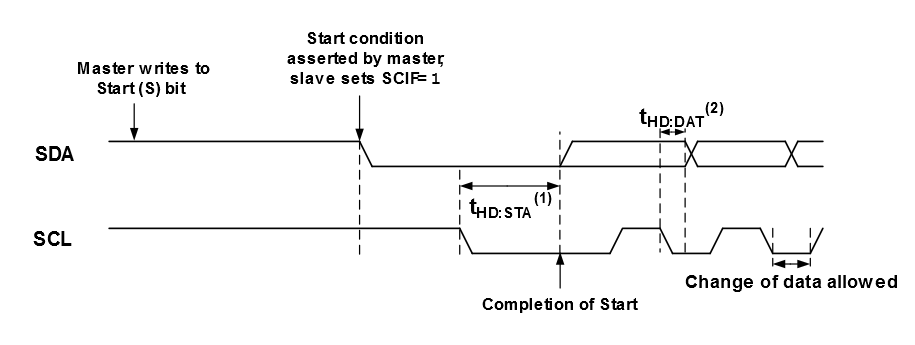
- 1.See device data sheet for Start condition hold time parameters.
- 2.SDA hold time are configured via the SDAHT[1:0] bits.
According to the I2C Specification, a bus collision cannot occur
on a Start condition. The Bus Free (BFRE) bit is used by the module hardware to indicate
the status of the bus. The Bus Free Time Selection (BFRET[1:0]) bits define the amount
of I2C clock cycles that the master hardware must detect while the bus is
idle before the BFRE bit is asserted. When the BFRE bit is set (BFRE =
1), the bus is considered in an Idle state, and a master device may
issue a Start condition. If there is more than one master on the bus (Multi-Master
mode), and both attempt to issue a Start condition simultaneously, a bus collision will
occur during the addressing phase of communication.
When the master asserts a Start condition, the slave hardware sets the Start Condition Interrupt Flag (SCIF), and if the Start Condition Interrupt Enable (SCIE) bit is set, the generic I2C Interrupt Flag (I2CxIF) bit is also set. The slave software must clear SCIF in order to clear I2CxIF and continue normal operation.