The USART module has four pins, named RX (receive), TX (transmit), XCK (clock) and XDIR (direction). In One-Wire mode only, the TX pin is used for both transmitting and receiving. The downside of this mode is that it only provides half-duplex communication. In Asynchronous mode, both RX and TX pins are used, thus achieving full-duplex communication. The XCK pin is used for clock signal in Synchronous mode, and the XDIR pin is used for RS485 mode.
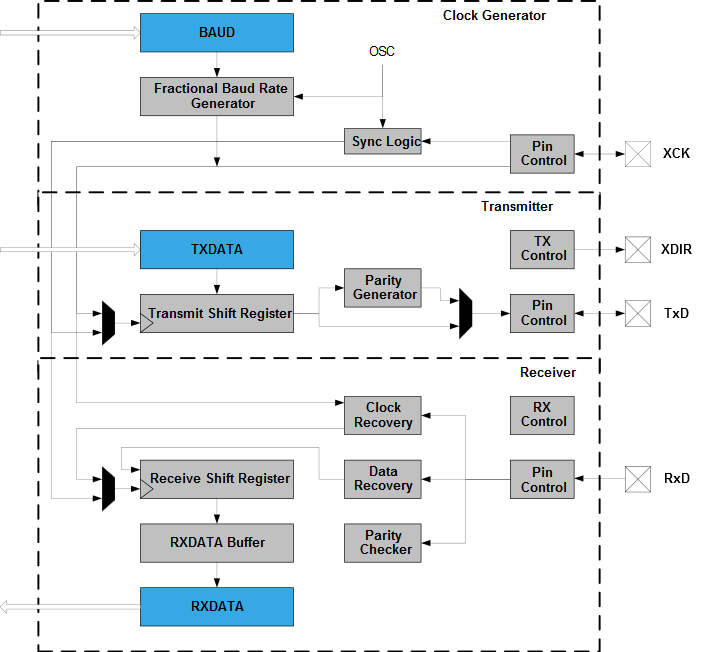
The most common USART configuration is referred to as “9600 8N1”, meaning 9600 baud rate, eight data bits, no parity and one Stop bit. A usual USART frame will therefore have 10 bits (one Start bit, eight data bits and one Stop bit) and will be able to represent one ASCII character. This means an “8N1” configuration will transmit BAUD_RATE/10 ASCII characters per second.
Moreover, the USART is a complex peripheral and can be used to achieve a handful of other protocols such as:
- Master SPI
- Slave LIN
- IR Communication
- Addressable USART (also called Multi Processor Communication)
- RS485