When enabled (CSD =
0), clock stretching is forced during
buffer read/write operations. This allows the slave device time to either load I2CxTXB with transmit data, or read data from I2CxRXB to clear the buffer. In Slave Receive mode, clock stretching prevents receive data overflows.
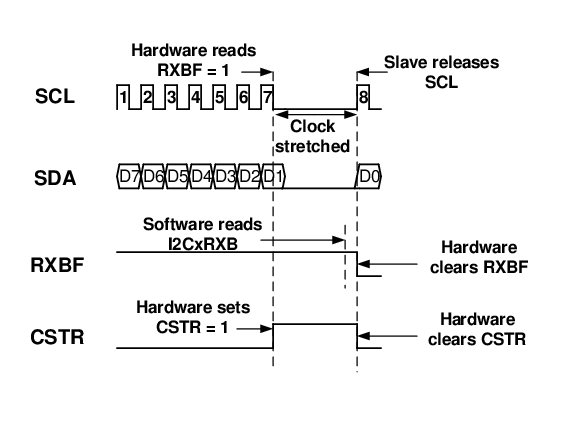
When the first seven bits of a new byte are received into the receive shift register
while I2CxRXB is full (RXBF =
1), slave hardware automatically
stretches the clock and sets CSTR. When the slave has read the data in I2CxRXB, slave hardware
automatically clears CSTR to release the SCL line and continue communication (see figure
below).Figure 1. Receive Buffer Clock
Stretching
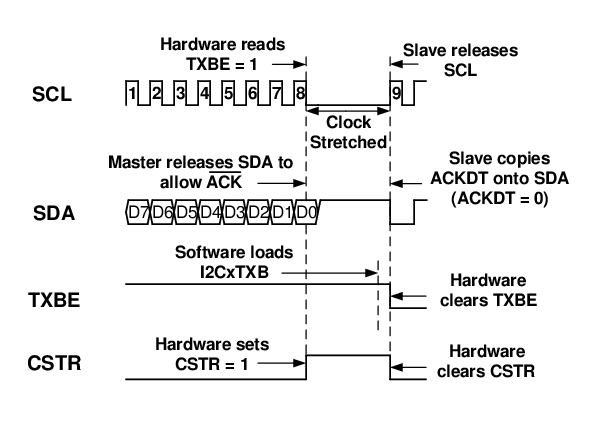
In Slave Transmit mode, clock stretching prevents transmit underflows. When
I2CxTXB is empty (TXBE =
1) and the I2CxCNT register is non-zero (I2CxCNT != 0), slave hardware
stretches the clock and sets CSTR upon the 8th falling SCL edge. Once the slave has loaded
new data into I2CxTXB, slave hardware automatically clears CSTR to release the SCL line
and allow further communication (see figure below).Figure 2. Transmit Buffer Clock
Stretching