A Restart condition is identical to a Start condition. A master device may
issue a Restart instead of a Stop condition if it intends to hold the bus after
completing the current data transfer. A Restart condition occurs when the Restart Enable
(RSEN) bit is set (RSEN =
1),
either I2CxCNT is zero (I2CxCNT = 0) or ACKSTAT is set (ACKSTAT = 1), and either master
hardware (ABD = 1) or user software (ABD =
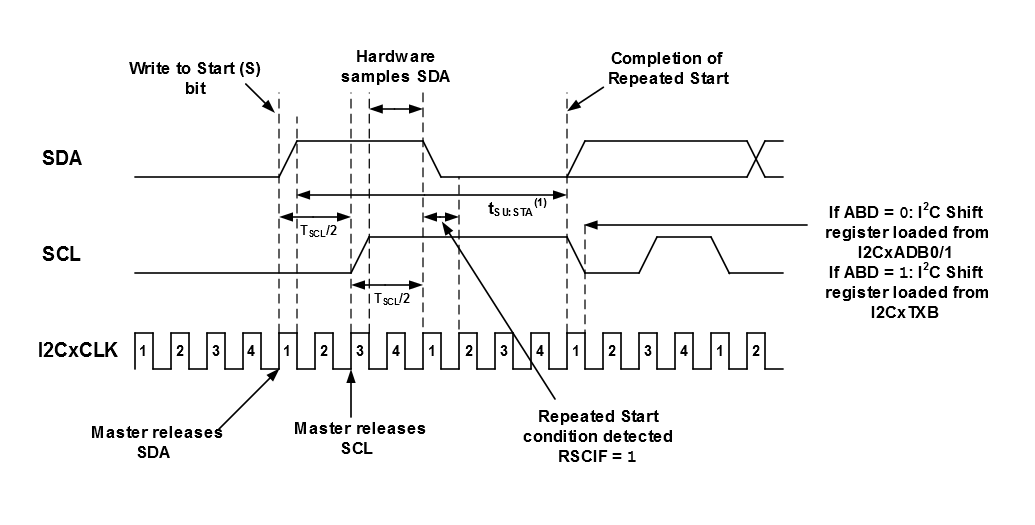
0) sets the Start (S) bit.When the Start bit is set, master hardware releases SDA (SDA floats high) for
half of an SCL clock period (TSCL/2), and then releases SCL for another half
of an SCL period, then samples SDA (see figure below). If SDA is sampled low while SCL
is sampled high, a bus collision has occurred. In this case, the Bus Collision Detect
Interrupt Flag (BCLIF) is set, and if the Bus Collision Detect Interrupt Enable
(BCLIE) bit is also set, the generic I2CxEIF is
set, and the module goes idle. If SDA is sampled high while SCL is also sampled high,
master hardware issues a Start condition. Once the Restart condition is detected on the
bus, the Restart Condition Interrupt Flag (RSCIF) is set by hardware. If the Restart Condition Interrupt
Enable (RSCIE) bit is set, the generic I2CxIF is also
set.
Figure 1. Restart Condition Timing
Important:
- 1.Refer to the “Electrical Specifications” chapter for Restart condition setup times.